PUNK IS TOAST: Q&A with BILL BAILEY and JOE MAGEE
Comedy legend Bill Bailey and filmmaker Joe Magee have collaborated for 20 years on a series of over 50 short films including standalone shorts for TV, films and animations for Bill’s live stand-up shows and other works. Always experimental, the films have ranged from the 1-min lo-fi shot on a phone to the ambitious 12-min epic shot on 35mm film.
For the Stroud Film Festival many of their works were screened back-to-back at The Goods Shed (SVA) and followed by a Q&A on stage with Bill and Joe hosted by Sean Roe (Klang Tone Records, Woolheads).
BILL
Hello everyone - good to be in Stroud, the Motherland. Wow. Home of Sadé. Didn't she move to Slad? Sladé, as it's now called. I'm Bill Bailey, this is Joe Magee, this is Sean Roe, and this is the Q&A.
SEAN
Right, what I want to ask Joe and Bill is how long they've known each other?
JOE
I think around 25 years.
SEAN
How did you meet and what got you to work creatively together?
JOE
I was living in Manchester and my brother was living in Edinburgh and through conversation, he was telling me that he was hanging around with this comedian, this guy called Bill Bailey and that he was going to come and see Bill’s gig in Manchester, Bill hadn't been on TV at that point or anything. He said, “Oh, after the gig we'll come round to your house and we'll bring Bill and his wife along.” So, sure enough they turned up and actually I did recognise Bill because I'd seen him at my local pub in a double act called The Rubber Bishops.
And then we sort of knew each other for probably about 10 years, without ever really considering there could be a kind of crossover, between the comedian and the artist. I think when Bill decided to do Tinselworm - which was his first super large, arena tour - it became clear that some visuals would work and he got in touch.
SEAN
So Tinselworm was the first time you really collaborated on a large scale, would you say?
BILL
Yeah, that's right. I mean, before that, I had the idea for visual elements to the show - a show I did a few years before that called Part Troll, had a few video segments to the show assembled from library footage and various sort of oddments. I didn't really know what I was doing. It wasn't as curated or as refined as the kind of stuff that Joe does. And so, when I came to do the arena show, I thought I'd love to do a much more of a spectacle.
When you perform in large venues you need to have some magnification so that the audience at the back can see your face. And normally, this is a couple of cameras and they project your face onto a huge screen. It's all a bit impersonal, but that's the nature of arena style entertainment.
SEAN
This is in Wembley. And just to tell everybody here, the audience size is around 13,000 people. So, it's massive.
BILL
Yes, it was a bit of a step up from the Marina Theatre in Lowestoft! I mean, honestly, I still get that feeling now - how did this happen?
So we had options of how we would put the magnification on the screen, and eventually, we hit on the idea of five separate LED screens - modular LED. So, it's basically tiny little modules about this size, which all fit together and create this huge screen on which we showed all these images.
That led to these films that we worked on like Hosenbügler, which is German from Trouser Press. And the ‘rewind’ segment after the end of the first half where, the gig sort of goes back too far, goes back to the 70s, then to the 50s, then it goes back to the Louis Quatorze era. All these ideas which I had in my head, which previously, hitherto, I hadn't been able to resolve or realise on stage, with Joe, I was able to do all that.
SEAN
You've continued through a sequence of these larger performances to use Joe's work, but you also do smaller events as well, do you not? I mean, more sort of intimate performances.
BILL
Yeah, that led to a long collaboration on many other projects, not just the large-scale stand-up gigs, but also short films.
SEAN
What is the most recent work that you did together then?
JOE
It was a DVD cover – I also do a lot of print work with Bill. But actually, we should probably stick with films, shouldn't we? So, Love Song, that was the last one [a short film starring Bill Bailey and Emma Thompson]
SEAN
And this was screened on television, on terrestrial TV?
JOE
Well, it was commissioned by the BBC, but it was for online only, for some reason. You can watch it online.
BILL
It was one of a series of short films, called Funny Valentines, commissioned by Shane Allen, who's the company commissioner at BBC. They were short films looking at all aspects of love. And I had this song that I performed many times called Love Song, which is a dark kind of unravelling of a relationship. And the idea came to me, ‘why don't we just make a video of that song?’
A lot of these dark videos, the emotionally raw ones, they always seem to have a wolf in them. There's always a wolf, do you know what I mean? In these emo songs, there's always a wolf in a church somewhere. So I thought, we have to have a church and a wolf. We'll start with that and then see where we go from there. Actually, it's more like a weird wolf, husky cross?
JOE
Yeah, it's half wolf, half dog.
BILL
Yeah, massive, this dog though, I think it's called Wolfie, which didn't help. And we shot it in a church in West London, and it was great fun.
JOE
It was a song that you'd probably performed several hundred times live. I think a lot of the tour films that we created had all been played out live by Bill without visuals. I think Bill likes to make sure that something works, developing work live, and then it's only when you're sure it's a successful song or sequence or gag…
BILL
…you get the timing of it, you get the dynamic of it right, and then at that point it's in a polished state enough that you can then add the visuals to it.
SEAN
Right. So, the guitar that you used in the love song... Was that Rick Nelson's guitar? Did you get that manufactured?
BILL
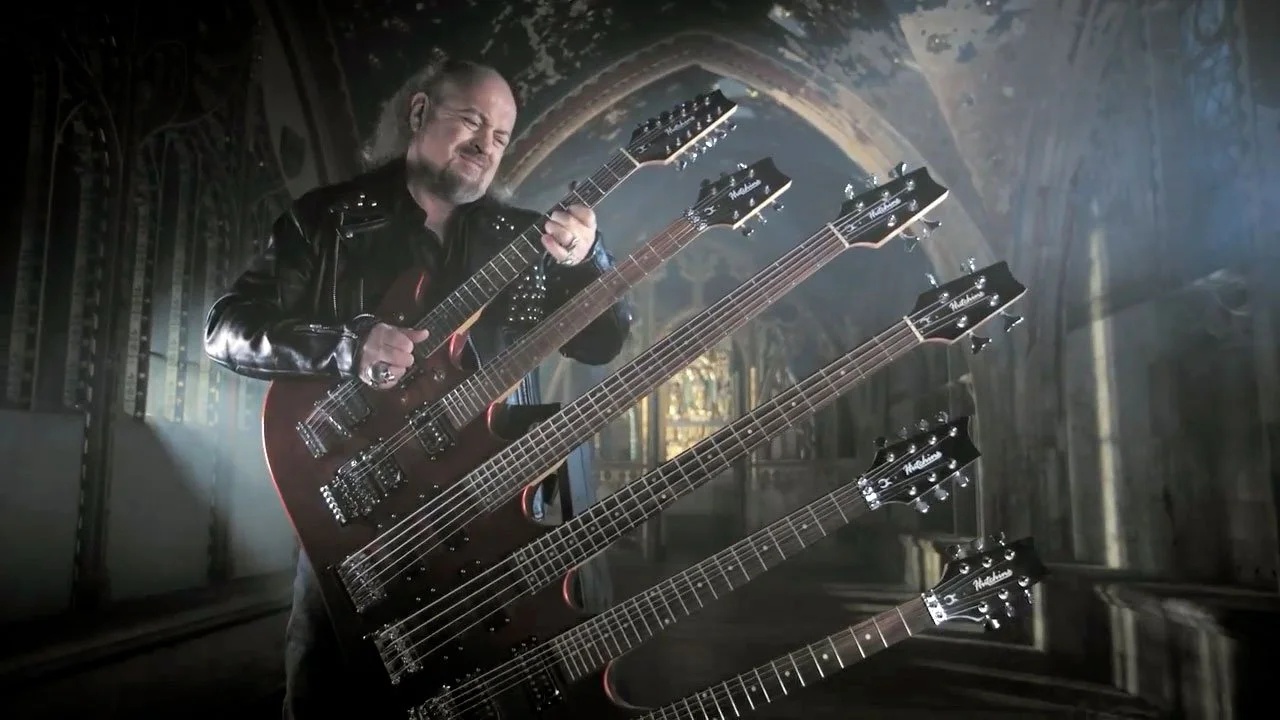
Do you know what? That was a birthday present from my wife. It’s a six-necked guitar, and it takes an hour and a half to tune, so it's not very popular. It’s in the Comedy Museum in London now, on the wall. I don't have anything more to do with it.
SEAN
Is it worth playing all six necks? I mean, would you actually bother tuning all of them?
BILL
No, you wouldn't, unless you were a guitar nerd like me. I once did a charity gig with it, and I don't want to name-drop, but Prince Charles (bless him), was there, and he came over to me and goes, “How do you play the bottom necks? Do you have to have a fake arm?” And I was thinking, ‘Am I getting trolled by the future king of the realm?'
But no, those two films - Love Story and Car Park Babylon - I haven't watched them in a while, but it's brilliant to see.
Stand up is a very solitary profession, you know - I’d write it myself, perform it myself, when I'm on tour, I go back to the hotel, I'm on my own. You're pretty much on your own a lot of the time. And when you're trying to find a collaborator, it's great to find someone who you can trust their judgment, can trust their artistic eye, and what they bring to it. And I feel very fortunate that we've had this collaboration over the years, because it's led to some of this, to some great pieces. I mean, it's extraordinary to me, I mean, this is like 15 years of my life flashing before me tonight.
SEAN
It was quite fascinating, because a lot of the footage you've not actually seen - you were actually laughing at some of the material.
BILL
Well, some of this stuff I never got to see, like the Tinselworm opening, this sort of evolution sequence, which is extraordinary. It starts with a sort of blob, and then it evolves into Einstein, and then it evolves into a bat, and then it evolves into this extraordinary animated sequence at the end. I never saw that, because I was backstage, you know, in my pyramid of dreams. But no, it's been an extraordinary body of work.
JOE
I can't believe you think stand-up is a solitary occupation.
BILL
It is.
JOE
I think that about being an artist. A lot of artists are just in the studio, pottering about. But with film, you have to collaborate.
SEAN
You see the credits at the end of the film and dozens or even hundreds of people are involved, even in small projects.
JOE
When you've written something, and you've got to go to someone else with that, there is a leap of faith you have to take in sharing your idea with someone and I'm sure any filmmakers here would know that it can be quite nervy, can't it?
BILL
It's good, though, having someone who is your collaborator, your wingman, whatever, to fight your corner for those artistic decisions, because often, producers or whatever will step in and say, "Oh, can we make it more like this?” If there's two of you, you make a more convincing case for something to go in a certain direction. So I think we were able to maintain that sort of creative control over it.
SEAN
There are funding issues as well with film, it's an expensive business, too, of course.
JOE
Yeah, I remember with one film it was quite a big budget, and you're surrounded by these people - exec producers and people who have got so much influence - and it can be quite difficult. I found on that film, they tell you to come in to do the edits at such-and-such a time, but they'd already be in there, and had started their own editing, so then you're struggling to have an impact…
SEAN
…and this is with a, what, a 10 or 12 minute film?
JOE
Yeah. I think all films are like that.
BILL
It can be a struggle, and the more people you've got on side, the better - you need people you can trust artistically, creatively, who will be able to see whatever your vision is, and see it through to the end. It can be a real tussle. It’s a battle of wills sometimes, you know.
SEAN
Just to change the subject, but one thing that I was thinking in watching all of these little segments joined together - I felt that there was a shared love of surrealism with both of your works. That's the linking factor, am I right in feeling that?
JOE
Oh, definitely, yeah.
BILL
Absolutely. Themes start to kind of emerge, which I've noticed seeing them all strung together like that. I've always loved that idea of a different point of view - with comedy, and I suppose it's become a cliche almost, it's described as being a sort of sideways look at the world. With visuals you can literally do that - you can literally see the world from inside a laser scanner, you can see it from inside a till, you can see it from inside a car park machine, and so it was brilliant finding a kindred spirit in that with Joe.
SEAN
Yeah, the surrealistic ideas in your comedy are sort of duplicated and emphasised by the visuals.
JOE
Yeah, I mean, with Bill, there's so much surreal humour going on, and there always has been, I think, right from the beginning with Bill's stuff, and it was a joy to be invited into that. It just suits filmmaking, and you can take it almost anywhere
BILL
Yeah, we had a lot of fun making those films.
SEAN
And the tattoos that were featured in one, I just wanted to clarify that they weren't real tattoos, I mean, the dogging site, for example, that is something that you wouldn’t really want.
BILL
No, but...
AUDIENCE MEMBER
Show us your tats!
BILL
Show us your tats, yeah! But I've got to say that I was genuinely asked by PETA to do this campaign “I’d rather go naked than wear fur”, and the reason I didn't, was not that I didn't support it, but that I've got so much hair on me that naked it looks like I am wearing fur anyway!
But yes, those tattoos are just brilliantly done, they look utterly convincing, and that's a testament to Joe's skill at being able to interpret a comic idea, and produce it and replicate it in a way that actually matches perfectly in a stand-up show. It’s unseemly to talk up your own work, but I think it's kind of unique, in many ways, what we've managed to achieve over the years.
JOE
I think it is, especially some of the live stuff.
BILL
Yeah, it's almost like a different sort of, or a new form of a joke, if you can see it that way; like, the set-up of the joke is done verbally and the pay-off is done visually. In the context of a live show, we had to sort of tee up a little bit of the stand-up so you could see the pay-off visually. It worked so well. I can't imagine working with anyone else to get that effect.
SEAN
So, we have several hundred people here - I think we should open this up to the audience. The only technical hitch is that we have no microphones, so if you have a question, please shout.
AUDIENCE
Do you ever have creative arguments, and how are they resolved?
BILL
Oh, yeah. I think there were always arguments about just tiny details. I think the broad brush of the comedy we were both in agreement on, and I think in many ways it was Joe's ability to technically facilitate certain things, which allowed me a bit more creative room.
I'm used to being in a live scenario, where I would think of a joke, road test it, yeah, not quite there, let's try it out a few times, and then finally polish it and get it right.
I'd be slightly reticent sometimes, but having worked with Joe over many years, I'd sort of trust his judgment on things. He would say, “Well, let's try it like this, I think that would work.” And I might pull back a little bit, and then Joe would say, “No, no, I think that's fine, let's go with it.
Particularly on the five-way conversation in Tinselworm: I look at it now, like ‘What the hell was I thinking?!’ I’m doing a conversation with my psyche in front of 13,000 people. [During the show, the live feed screen of Bill in close-up splits into five elements of his personality who end up squabbling with the real Bill and each other]. But, you know, we pulled it off.
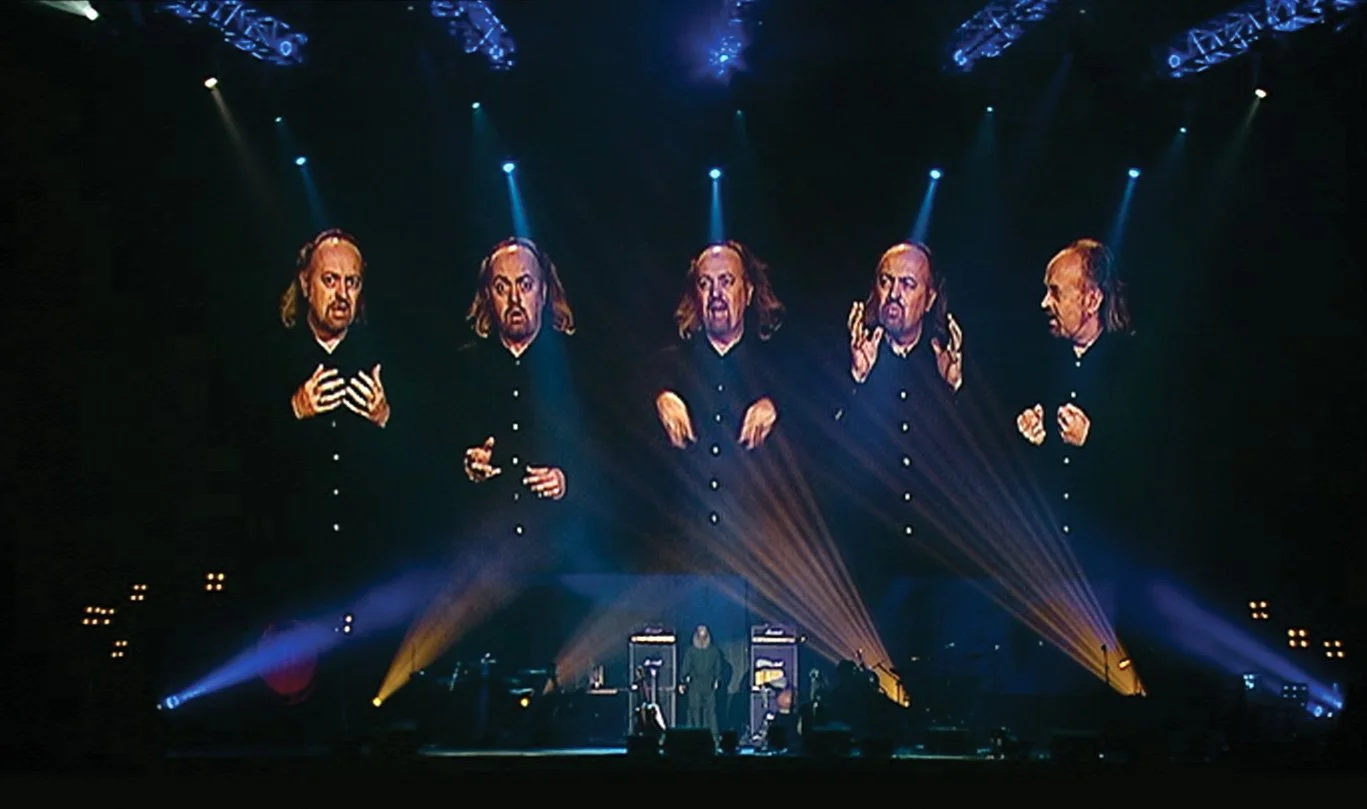
Bill Bailey, ‘Five-Way Conversation’ for Tinselworm, Wembley 2007
JOE
And that was 100% your idea. That was such a challenging piece of film to make, because Bill had to work out what was being said, then say it, then we had to pre-record five different Bills, and finally Bill had to stand on stage on a certain mark at a certain time and make sure the camera was hitting him at exactly the right point.
SEAN
I thought the sound design was really great, because you couldn't really differentiate - the voices were all very clear and very present, so that made it even more confusing to watch.
BILL
Yeah, that was a big technical operation, that whole show. We had a huge crew, a vision mixer backstage, I mean, it was a huge kerfuffle. I remember when I was touring that show, and I think I was in Newcastle at the Metro Arena, and I looked out the back of my dressing room and there were 11 articulated trucks in the car park. I thought, “Blimey, who's on? Britney Spears or something?” And then somebody said, “No, no, that's yours, Bill.” My God. So, it was a big deal.
SEAN
Okay, another question?
AUDIENCE MEMBER
Obviously there was some overlap between when you were doing Black Books, and when you started doing a bit more of the videos within your shows. Is there any influence that you felt came about as part of the structured comedy you did for TV, that then bled into the videos you did live.
BILL
That’s a good question. I think that working in TV and film gives you a little bit more of an insight into what's achievable, and what will work. I was very lucky early on to work with Simon Pegg and Edgar Wright - we worked on a TV comedy called Asylum - and seeing how Edgar worked, and how you could manipulate things just by the way you shot something, that gave me a lot of insight.
I think it probably just went in by osmosis. And then in a live context, what Joe is so great at, he's able to interpret that, but in a sort of lo-fi way, almost like scratching the video.
JOE
Yeah, just as basic as possible. I mean, I've got no film training at all, so I just kind of made it up. When Bill got in touch and said, “Can you do some film stuff?’ I think I probably just pretended I could and thought, ‘Yeah, I’ll work out how to do it later’.
My default position is often just - what’s the least number of people we can do this with? So, for example, when Bill said, ‘I've got this bit about tattoos’ - I went to see the show, saw the verbal sequence, and I think Bill had been talking about making a film with it, but my immediate thought was, “No, let's just take a single photograph and then we'll zoom in on it, and play around with it. I always look to break it down into, ‘Can we make this with just the two of us? Sure we need three? Okay, let's use three’.
BILL
Simplicity is the way forward with it. If you think of a funny idea, it doesn't matter - you can shoot it on lo-fi. It doesn't have to be a flash camera. It doesn't have to be all the studio. If you've got the idea, the thought and the joke, and you realise it in some form, it'll still work.
JOE
So as lo-fi as possible. My instinct was that it would really feed what Bill was talking about and his aesthetic. I just felt that.
BILL
Definitely. It's a punk aesthetic. It's just slightly funny.
SEAN
Also, if you think of the films of Jean Cocteau, a lot of those amazingly memorable sequences were done very simply without digital effects or whatever, which they didn't have at the time as well. Just well-imagined and conceptually interesting, but done on the cheap, essentially.
JOE
I think a lot of artists are really interested in battling with their medium. So, for example, someone like Matisse, he would get his canvas and he'd attach his paintbrush to a broom handle and stand six foot away and use his wrong hand. It’s all about trying to encourage something spontaneous. And I think maybe using really basic equipment to make films, especially for the live stuff, is the same principle.
SEAN
Beta cameras. OK, another question please.
AUDIENCE MEMBER
Bill, you said that being a stand-up is a very lonely thing. To what degree do you think your collaboration with Joe has allowed you to enjoy your trade or your craft longer and more richly than you would have done if you'd just done the last ten years on your own?
BILL
I think that's a very good question, and I think that that's true. There was a long period, ten years or so, when each show had to have a kind of spectacle and have some set pieces. And it was fantastic having Joe on board for those shows.
Because I knew that we had a kind of a wow factor that could be put into a show at any point and I could build the rest of the stand-up show. And it made it fun. It made it a great collaborative, creative process - conceptual jokes brought to the stage and the screen using a combination of comedy and visuals.
The last couple of tours I've done, I've actually backed away a little bit from visuals and from having a screen, because I changed a little bit as a person and as a stand-up. A lot of my stand-up is now much more personal - it’s about my family, recollections, stories, anecdotes. There are less set pieces or spectacles now. I've gone into a phase where I like the audience to sort of fill in the gaps with their imagination.
JOE
I mean, it was amazing fun. But I always felt that the shows worked with or without the visuals.
BILL
Yeah, but don't talk yourself out of a job!
JOE
I always felt that the gigs were amazing without the visuals. I’ve said this to Bill on a few occasions - stand-up is an incredible thing in the sense that how often can one man or woman walk on stage and hold the audience for an hour and a half? You know, it's just beyond…I just can't comprehend it.
BILL
I mean, the point about them was they created something special and unique and I can't think of any other shows that really employed that so much. I went to see lots of stand-up, became obsessed with it. And I'd look at a lot of shows where people were playing arenas and it'd be one person, just with a microphone, no backdrop even. And I thought, 'God, you're missing a trick here’. There's so much we can do here with an audience. You can take them on a bit of a journey. You can suggest an idea to them and then realise it in a visual way. And I don't think anyone had seen anything like that before, or since.
Tinselworm was the combination of all of those ideas I'd had for many, many years and hadn't been able to resolve and realise. And it was a very creative process. Your question was whether that prolonged my interest in doing stand-up because, as you say, it's quite a solitary thing. And I think that's true.
Many stand-ups perform for a bit and then maybe they burn out or they don't want to do it or they want to work more on TV. For me, stand-up is the end in itself. It’s the art form that I would want to continue doing for many years. It's the thing which inspires me, the thing which really is the repository of all my ideas. Thoughts, visual, comedic, filmic, music ideas, all of those things can be put into a stand-up show. And the fact that we spent those years developing visual ideas has sort of sustained me for many years. So yes is the short answer.
SEAN
Another question?
AUDIENCE MEMBER
I've got a message for Joe. I really want to know - Johnny Rotten's head made out of Country Life butter: was it really made out of it? Or did you make it melt?
JOE
Oh my God. So yeah, I came up with this idea of making his head out of butter.
BILL
As you do. It's a normal sort of thing you do.
JOE
I made a mould out of latex or something and then I did melt some butter down it. I don't think it was Country Life. I think it was probably Kerrygold or Tesco's Value Butter. Actually, I think it was Smart Price. Was it even butter? I wasn't going to spend a lot of money on it. So I melted it all down.
BILL
I can't believe it's not butter.
JOE
Poured it into the mould and put it in the freezer or something. And then it just all kind of disintegrated when I pulled the mould off. So I had to kind of sculpt it with a knife in the end. Then I set a table up with a tablecloth to make it look like a kind of tea room. And had this sculpture and a blowtorch in one hand…
SEAN
A crucial bit of inventory.
JOE
… and a little instant camera in the other hand. Taking a photo of it. Blowtorching a bit more. Walking around it. I wanted that kind of punky aesthetic. So it was just a series of photos on a little camera. You wouldn't even call it filming. And yeah, it was butter.
AUDIENCE MEMBER
Hello. Where do you stand on the demise of film? You said that Car Park Babylon is on 35 mm. What was the thinking behind it?
JOE
The budget.
BILL
The budget was a big factor in that. If you make films now, or make TV now - it’s very high tech. I'm filming a comedy drama for Sky at the moment and watching the process of it is so different from that. I'm not to say they’re decrying the craft of cameramen and sound people. But it's all very high tech. The camera lenses - the focus is being pulled remotely, by someone else. The whole thing is done wirelessly.
With film, there's the actual can of film, somebody bringing it in and having to wind it around the camera. It was a beautiful thing to watch. I think it makes you think much more about what you're going to shoot. You have to conceive the shots more. That's my big thing - prep. I'm a total obsessive about that. When I prepare a show, I do it a hundred times in little venues. I write it. I go over it and over it and over it. And get it right. And I think with film you also have to do that. The pressure's on, to get that shot. Whereas digitally, you think ‘Well, we’ll shoot it again.’ With film, no, we’ve only got so much film, we have to get this right.
And so I think it actually focuses the mind a little bit more. What do you think, Joe?
JOE
Yeah, well, you just made me think about when we went from stills cameras to now. Nowadays, if you want to take a photo of your dog, you’ll just take 50 photos and then look through them and think, ‘Right, that's the best one’. Whereas, when you just had film in your camera, you could only take limited photographs, that’s it. And you couldn't actually look at the photos immediately. So you had to be more decisive about what you’re doing and be like Bill said, more prepared.
BILL
It's very much about the actual physical nature of the film. The constrictions on filming nowadays is just time. You can record it as many times as you want, it’s just about how much time do we have? We're paying for a crew. We've got a limited amount of shooting time. That's the budget. Whereas with film, it's more of a refined process. I loved it. I loved making that film. I think it was a great education in how to get a scene right. My God. Based on a true story, I was trapped in a car park.
It was Christmas Eve. I was in Westfield car park in West London and the machine took my ticket and said, ‘No, you still owe two pounds’. And I was panicking. What? And so I pressed the help button, and there was a party going on - I could hear it! People just laughing. Hello? Help? And then a guy in the machine said, ‘I will send credit to the machine’. But he sent credit to the wrong machine. He sent it to the machine across from where I was. And then he said, ‘I'll send someone to help you’. There was a lift next to the car park ticket machine and next to the lift, there was a door, I didn't even know there was a door. And it just opened and there was a guy there - like Mr. Ben just appeared out of nowhere. So, yeah, that was fun times.
SEAN
Okay, a couple more questions.
AUDIENCE MEMBER
Hello. So, if you had the choice again, would you go back to film?
BILL
I would love to make a film with film. I'd love to shoot stuff on film. It's sort of like the kind of pure art form of how to make film - it reminds me a little bit of how bands used to record albums. They would rehearse and rehearse and get the song absolutely right and only then would they go in the studio and maybe do it in one or two takes. And it captures a kind of energy, a crackle, that you don't perhaps get if you go back and record and record over again. There's something that happens, a magic. You capture lightning in a bottle that you don't perhaps get if you're constantly going back over and over it.
And I think the same is often true in filming. Like the other day, we did a take, the first take, and it was fine. But everyone's going, ‘Well, we'd better do it again. Just in case’.
AUDIENCE MEMBER
The ‘Safety Shot’.
BILL
Yeah, exactly. Safety. We'll do it again. But actually, you nailed it.
JOE
I've got to admit, I would differ a little bit because of what I was saying before about what's the easiest way you can do it and the cheapest way you can do it.
SEAN
It probably loses out quite a lot of the times then when you're talking about the cheapest way of doing things.
JOE
Well, I think film is absolutely beautiful, isn't it? And the resolution and the aesthetic and everything is unparalleled still, for some reason. But I think as soon as you're shooting on film, like with Car Park Babylon, we had so many crew - camera operators and assistant directors. And I don't know whether that was connected with the fact that we were using film. But I think personally, digital is all right.
BILL
No, no, absolutely. And I think that, you can pretty much achieve the same effects. And I think that there's not quite the same pressure. And certainly if you're on a low budget, or you're working with lo-fi, I mean, you can shoot these on a phone, you can shoot it on a small 4K camera and still get the gag or the idea across. I just think aesthetically, the kind of process of making a film on film…there’s some feeling of craft about it, which is not present in those other forms.
AUDIENCE MEMBER
It just has to be hyper-adrenaline when you know it's a film.
BILL
Absolutely, yes - there was exactly that. A sense of ‘I've got maybe one or two goes of this. I have to run down here, hit the mark, look here, the lighting's got to be right.’ And then we shoot it and then we've got to move on. And so what we did was, rehearse. Rehearse and rehearse and rehearse and get everything right.
You pick actors who are able to get it. We had a great cast n that and they were able to capture something in the moment. And as you say, it does up the adrenaline levels when you know you've only got a limited amount of time to do this or a limited number of times to take it.
AUDIENCE MEMBER
Taking it further than that, would you say in general, like, the limitations you place on yourself stimulate creativity?
BILL
I think so. We shot a lot of those in-show, short films, videos, on very low-fi bits of kit.
JOE
Yeah, as low-fi as possible.
BILL
And so you have to up your creativity a bit. You have to think of ways to achieve what you want to do with the limitations that you have. And I don't think limitations on creativity is a bad thing. I think sometimes, it’s actually a sort of spur, a catalyst for creativity.
It's a bit of a stretch, but Shostakovich - I mean, I'm not comparing us to Shostakovich by any means….
JOE
…why not?
BILL
…but, that was someone who was put under huge pressure to write certain music in a certain way. You know, the Soviet government said, you have to write it this way. And yet he wrote this beautiful music within those constraints.
That's always been one of the things I think about when we're in this situation: we have very little time and a low-fi means of performing it and yet, it's about the ideas. Always about the ideas. The ideas are there. It doesn't matter how you film it. They're going to somehow land. They're going to get through.
JOE
That's right. I agree. Self-imposing limitations - artists are doing it all the time. Why would you do a woodcut when you could take a photo? It's because you've got to struggle. You've only got one colour. The marks are so, kind of, crude. But, it forces you to really encapsulate what you're trying to say in a really basic kind of art form. It's similar to that - some of the films have just been shot literally on a stills camera. They’re a series of stills that have been animated afterwards.
BILL
The thing is, Joe has a unique skill in getting images and working with them, and manipulating them, and making them into something much greater than the sum of its parts. And that's a real testament to your skill as a filmmaker.
SEAN
Question at the back there.
AUDIENCE MEMBER
How does the role of music in the performance integrate and effect the films?
BILL
Having a lot of music in the show means that there's certain beats and certain points and dynamics that can be enhanced. It gives a kind of rhythm to a piece. It's very much like making a pop video, almost. Some of the sequences were my favourite - I loved the Tesco sequence. Joe is actually in that. He's one of the people. He's the woman with the wig on, holding up the...
JOE
…the megaphone.
BILL
So, you know, above and beyond there!
JOE
... Actress didn't turn up.
BILL
No. Fair play - you’ve got to do what you've got to do. Those are the things that I just think work really well. Because, as you say, music is a way to cut through to people in a way that spoken word comedy doesn't. It's one of the two great loves I have - spoken word and music.
And I think musical comedy hits in a different way - it’s on a gut level. And I think then you sort relax a little bit.
You know, spoken word, you have to concentrate. Music, you can sort of experience it on a different level. And that's when the visuals are so important because every single beat, you can put something in. We take in so much visually - eighty, ninety percent, we're visual. And so it taught me a lot, actually, working with Joe and making these films - you can be so sparing with the comedy, with visual. Because it's instant.
With a line, a gag or a thought, it takes a while to percolate into an audience. But a visual gag hits instantly. It allows you a lot of economy. You can put in so much visually because it happens so quickly.
JOE
That particular film where Bill stares into the laser scanner - I think that began as a song without any visuals. It was kind of an Acid House song, with a series of samples, wasn't it? “Please insert your club card”. I think Bill said something like, “Can you come up with something for this Tesco two-step?” And through the process of coming up with that film, the song changed, didn't it? So you dropped the kind of sampled voices coming out of the machines. I think it really evolved.
BILL
The film tells a story. It's very much a show and tell. With a musical or verbal way you have to explain a little bit. But film allows you a bit more latitude, a bit more freedom. You can just allow the visuals to tell the story. And that's what that does.
SEAN
When you're playing keyboards live at these big events... And you're facing the audience, of course. But the visuals are back projected behind you. You don't have difficulty staying in quite tight sequence? Is that not an issue that can happen?
BILL
It was an issue and I fixed that by having a little monitor on my keyboard. So I could see exactly what was happening.
SEAN
So when you're saying video is the tempo, essentially...
BILL
…yeah, I was able to monitor it.
JOE
Well, not in every case, though. Actually, before I was on the scene, Bill had got this software - Bill’s got a musical keyboard, I don't know what it was but it’s got some kind of software that synced visuals to the keys on the keyboard. So it was almost like you could ‘play’ a film.
BILL
Yeah, so it was a MIDI keyboard. And the MIDI keys were linked to little video films.
JOE
You could have a kind of open mouth and closed mouth - so Bill could kind of make the mouth talk. And each key was assigned to a still image.
BILL
And I'd play that scale. In fact, I had a scale of shame once - it was, you know, Hitler, Mussolini, Chris de Burg
JOE
So some of those films are actually broken down into little sections, which are triggered sometimes by Bill, but also sometimes by a guy just off stage.
BILL
Sometimes the timing is all. Sometimes you need to be able to trigger the film at a certain point in the music. And sometimes the whole thing can be a film that has been pre-recorded. But I love to keep that live element. I think sometimes you have to read the timing, the rhythm of something, and then play the image at a certain time. And so, almost in a way, it's like playing the film. It's like allowing the film to sync with the music, and me having control of that on stage. I think that was quite an important part of it.
JOE
Yeah, I think that's amazing - because when you go and see a live show, you really do want the liveness, don't you? And I think that ability to be able to ‘play’ a film, dictate the tempo of it according to the audience, and what's going on, is an amazing thing, and makes a lot of those films quite successful. But other ones, we just couldn't do that, and we had to create a single conventional film.
AUDIENCE MEMBER
Really enjoyed tonight, thank you. But did you get the same vibe of being invited around to your mate's house because he's just got a new camcorder, and wants to show you some new videos?
BILL
Yeah, that's right. Yeah, I did get that, actually. I was thinking, this is great. We're all sitting around watching some old videos. [LAUGHTER] I hope you got that vibe as well, because I really enjoyed tonight. Thank you so much for coming. Honestly, I really enjoyed it. [APPLAUSE ]You know what? Just about a week ago, I didn't know I was going to be able to come tonight, because as I say, I'm filming, and the schedule was all completely haywire. And I'm so glad I was able to come.
Joe sent me a link to that montage and honestly, I was knocked out. I honestly couldn't believe we'd done so much over the last few years. And also the range of things that I've come across. You know, the film, short films, videos, gags, graphics, all of those things. It's been an extraordinary time.
So thanks, Joe. Give me a high-five on that one. [APPLAUSE]
JOE
I always know that when people pay to see Bill, they're paying to see Bill, not the films or anything like that. So thank you so much for the dream job I did over these years.
BILL
No, thank you. It's been great fun.
BILL
And thanks to all of you for this. What a great venue this is. Hey, I might come back and do a gig here. What do you reckon?
[CHEERING]
BILL
Oh, no! I've said it in front of witnesses!
SEAN
So, yeah, thanks to Joe over here, to SVA, and to the Stroud Film Festival for organising all of this, basically. Thanks very much.
BILL
Thanks, guys.
JOE
Thank you.
[APPLAUSE]